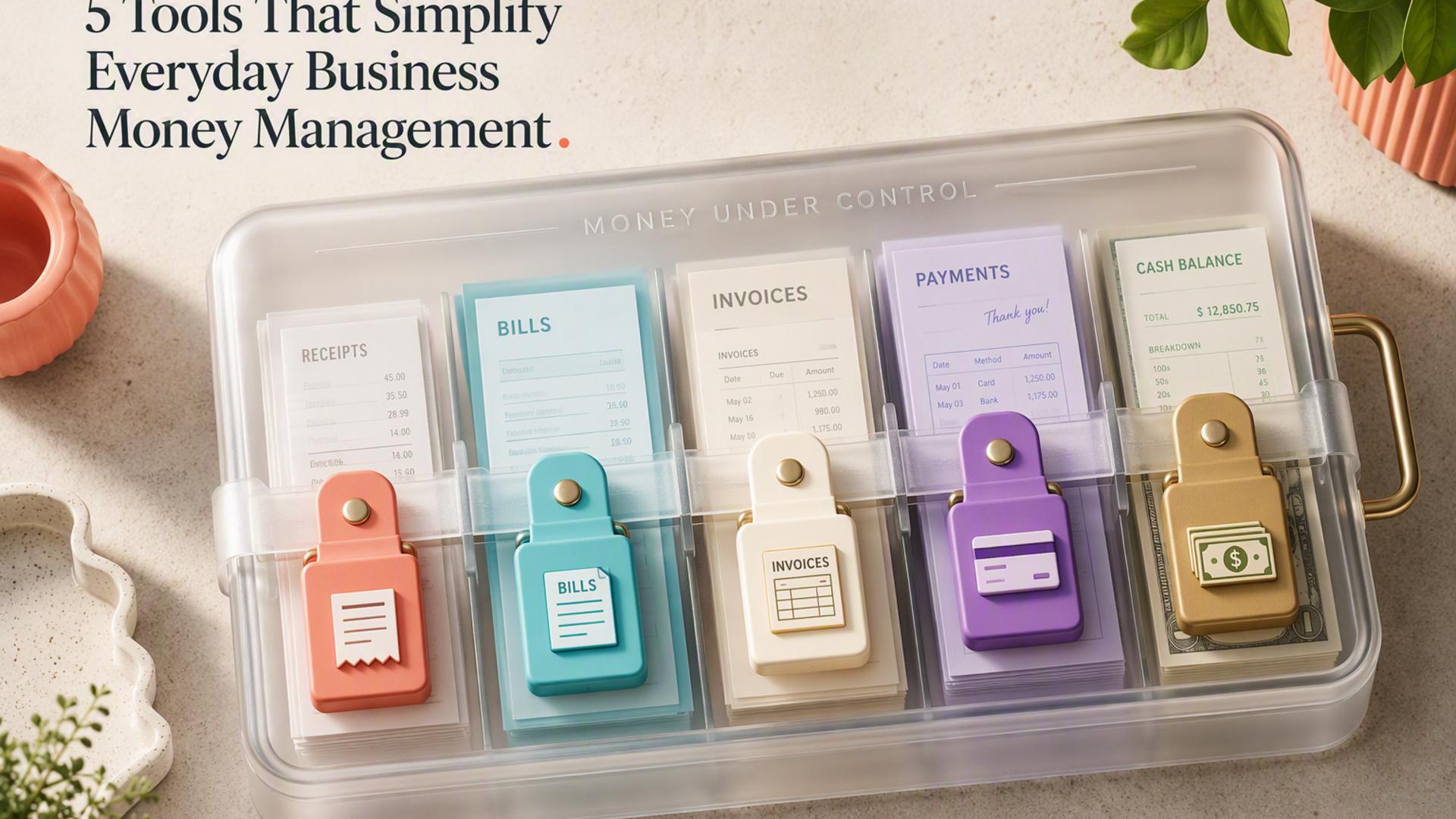
5 Tools That Simplify Everyday Business Money Management
For many small business owners, financial stress is rarely caused by one major issue. More often, it builds through small daily problems: an unpaid invoice, a misplaced receipt, an unexpected bill, or a bank balance that differs from expectations. Each issue may be manageable on its own, but together they can create ongoing financial unease.
Business owners who avoid this persistent pressure are not necessarily more skilled with finances. Instead, they use a focused group of apps in their regular workflow to reduce those recurring friction points automatically. These tools keep financial information accurate and up to date without demanding continual hands-on attention. That kind of setup can look like this.
1. Sage Accounting: Software for Accounting and Cash Management
Sage Accounting provides the foundation for the wider financial setup. It links with bank accounts to import transactions automatically, monitors money received and paid in real time, handles GST, HST, PST, and QST calculations, and creates cash flow forecasts that outline the expected financial position in the coming weeks.
Instead of looking at a bank balance and making assumptions, Sage offers a clear and accurate picture of current funds and where they are being allocated. For Canadian small business owners seeking greater visibility over their finances, this real-time view can make a significant difference. Plans begin at an accessible price point and expand alongside the business, without requiring long-term contracts.
Why it matters: Reliable, ongoing financial visibility reduces the uncertainty behind much of the everyday pressure associated with managing small business finances.
2. Relay: App for Business Banking
Clean, low-stress financial management begins with a dedicated business bank account supported by effective digital tools. Relay is a business banking platform for Canadian businesses that provides multiple accounts through one dashboard. This enables owners to assign funds deliberately, such as using one account for operating expenses, another for GST and income tax reserves, and another as a savings buffer for unforeseen costs.
With money arranged in this manner and presented through one straightforward interface that integrates with accounting software, business owners can more confidently determine whether they can manage an expense or meet a forthcoming obligation.
Why it matters: Business banking with organized, separate accounts helps clarify the purpose of every dollar and reduces the uncertainty that contributes to financial stress.
3. Dext: App for Capturing Receipts
Business receipts accumulate every day, from fuel stations and suppliers to restaurant meetings and online tool subscriptions. Those expenses may be legitimately deductible, but only when they are properly captured and recorded. Dext enables users to photograph receipts immediately with their phone, automatically extracts the relevant data, and sends it to accounting software without manual data entry.
As a result, expense management can take seconds within the regular workday instead of becoming a stressful month-end task involving missing receipts and forgotten details.
Why it matters: Recording expenses as they happen supports complete records, maximum deductions, and avoids a month-end exercise in rebuilding expense information.
4. Pleo: App for Business Spending
Even small businesses with one or two employees making purchases on the company’s behalf can face continuing financial and administrative pressure from spending that is not tracked. Pleo provides smart business spending cards, automatically collects receipts at the time of purchase, categorizes transactions, and sends the information into accounting software in real time.
Each business expense becomes visible straight away, properly categorized, and supported by a receipt. There is no need for an end-of-month expense claim process or manual reconciliation. The outcome is a complete and current view of spending without surprises.
Why it matters: Immediate, comprehensive oversight of business spending keeps financial records accurate and prevents unforeseen costs from emerging at month-end.
5. Plooto: App for Payment Automation
Manually making and receiving payments can create substantial cash flow pressure for Canadian small business owners. Sending e-transfers, issuing checks, and following up with clients over overdue invoices all add friction. Plooto automates payments in both directions, enabling businesses to pay suppliers and receive customer payments from one dashboard while automatically reconciling activity against accounting records.
When customers can pay through a straightforward payment link and supplier payments are scheduled automatically, cash flow becomes considerably more predictable. Late payments and missed payments become less common, while accounting records reflect actual activity rather than assumptions about what may have occurred.
Why it matters: Predictable, automated payment processing reduces both the manual work and uncertainty that can make cash flow management more stressful than necessary.
Frequently Asked Questions
How can I tell whether my business has a cash flow issue or a profitability issue?
These are separate challenges and need different solutions. A profitability issue occurs when business revenue is insufficient relative to costs. A cash flow issue arises when the timing of incoming money does not match the timing of outgoing payments, even where the overall financial position is positive. Many small businesses are profitable but still encounter cash flow difficulties, especially when client payments are slow or major costs occur at the same time. Accounting software that shows both profit and loss information alongside a cash flow forecast makes the distinction much clearer.
Is connecting a business bank account to accounting and payment apps secure?
Established platforms use secure, read-only bank connections through regulated open banking channels or direct agreements with banks. These connections do not require the sharing of banking login credentials. They allow an app to view and import transaction information, but cannot move funds without explicit authorization. Major financial institutions use the same technology, and it is considered safe for normal business use.
How frequently should business finances be reviewed?
For most small businesses, a brief review every day or every other day of bank balances, unpaid invoices, and alerts from accounting software is enough. A more detailed monthly assessment of profit and loss, cash flow, and approaching large payments helps maintain visibility without taking too much time. Cloud accounting software makes this process faster because the information remains organized and current, allowing the review to take minutes instead of hours.
What is the most effective way to prevent an unexpected cash shortage?
Most small business owners can receive enough warning to act before a cash shortfall occurs by combining a cash flow forecast that projects the next thirty to ninety days, a tax reserve account that builds during the year, and a clear overview of unpaid invoices and upcoming payments. The important factor is using these systems consistently rather than checking them only when something appears to be wrong.
What should happen when a client pays late?
Late client payments are among the most frequent causes of cash flow issues for small businesses. The strongest protection combines clearly stated payment terms in an agreement or invoice, automatic reminders issued before and after the payment due date, and a simple payment method that makes it easier to complete payment. When clients receive consistent reminders and have an immediate way to pay, late payments typically decline significantly without the need for uncomfortable discussions.